How to Choose a High-Speed Door for Your Facility
What this guide covers
High-speed doors are bought for one reason: openings that cycle constantly. Every minute the door stands open, conditioned air escapes and dust walks in. This guide covers the decisions that matter, based on how these doors are actually built and used.
Rolling vs stacking
The two constructions differ in how the curtain parks. Rolling (rapid roll-up) doors wind the PVC curtain onto a drum above the opening — compact, and the most common choice for standard interior openings. Stacking doors fold the curtain layer by layer; they suit larger openings and high wind-resistance requirements. Materials, principles and requirements are roughly the same for both — choose by opening size and wind load, not by fashion.
Speed: 0.6–1.2 m/s
Our high-speed doors open and close at 0.6–1.2 m/s, adjustable via the frequency converter. Faster is not always better: match the speed to traffic — forklift crossings justify the top end, pedestrian pass-throughs don't need it. Accurate positioning from the encoder matters more than headline speed.
Sealing: match it to the room
Double-sided sealing brushes on the frame plus an elastic PVC bottom that adapts to uneven floors give thermal, dust, insect, odor and sound insulation. For food, pharma and cleanrooms, sealing is the primary spec — ask for the brush and bottom-bar details, not just the curtain.
Safety: non-negotiable
Infrared protection and airbag protection should stop or reverse the door on any obstruction, backed by a deceleration buffering stop. If a supplier can't describe the safety chain precisely, keep looking.
Specifying checklist
- Opening width × height, and wind exposure
- Traffic type and cycles per day
- Room classification (food, cold storage, cleanroom?)
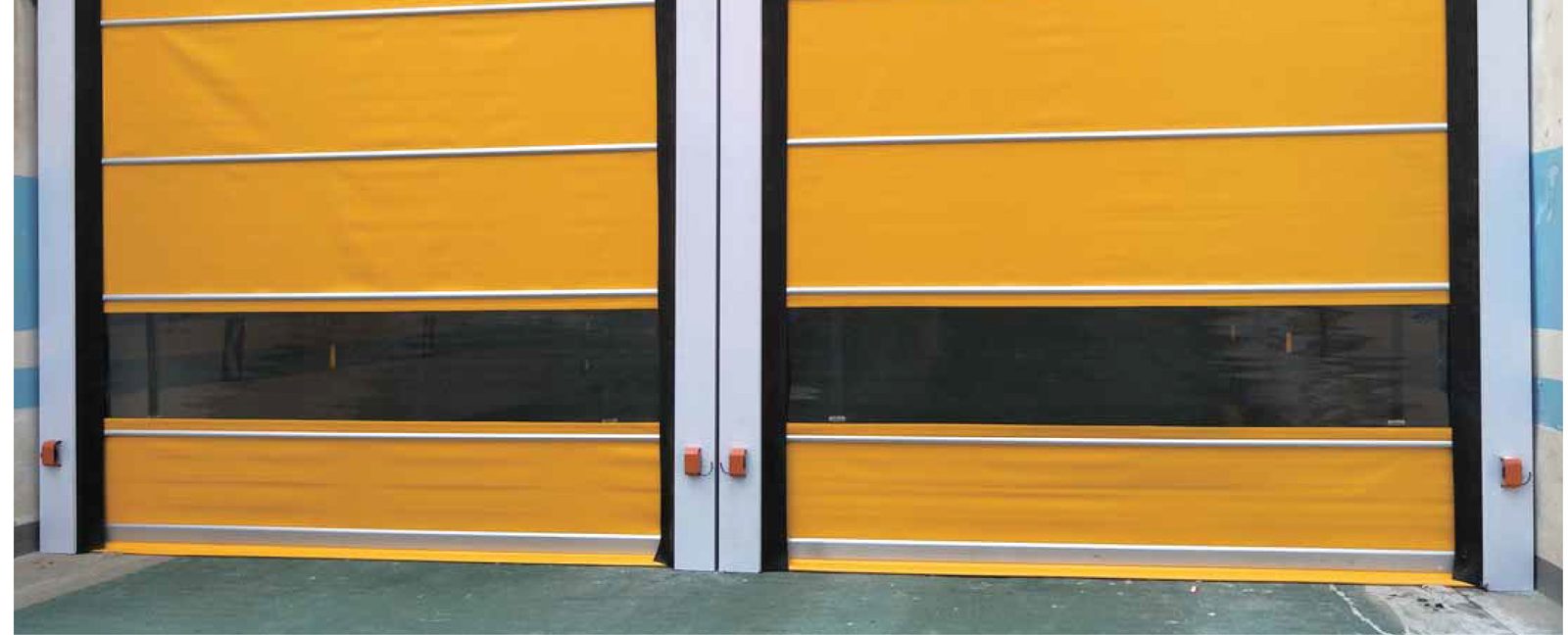
- Curtain color and vision-window shape (rectangular/elliptical)
- Control mode and access integration
Send us the checklist answers and our engineers will configure the right door — request a quotation.